Sunday, November 4, 2018

Changa Chet movie review:

This week’s release ‘Changa Chet’ has potential to attract at least one big segment of the Nepali audience—this production has almost everything it seeks in a movie, such as money crime love and lust. Yet, for another class of moviegoers, the most significant thing they will remember is that its producer is standing trial for forging banknotes ‘used in the production’. The movie has nothing substantial.
Changa Chet, overall, is an average production. Its story has a kick to keep the audience hooked. Yet, there are a number of flaws in the story and other cinematographic technicalities.
Interesting Story
While crime is considered one of the top news elements globally, money and sexual desire come are prime drivers of crime. Changa Chet is based on this perception. Without delivering any moral lesson, the movie shows how money and sex leads people into committing crime. Here, not only the villains, but protagonists are also criminals. The only difference, perhaps, is the severity of crime and the circumstances that lead them to crimes. This makes the story interesting for the general audience.
Connecting the story with the daily life of the people, the movie is a realistic portrayal of urban poverty. It shows the struggles of Nepali youth who come to the capital with big dreams. It also shows how these youth are cheated– sometimes by mean house owners who ‘torture’ them over trivial issues and other times by ‘international projects’ which offer lucrative jobs to them before shutting down the office and running away. The movie is also successful in portraying corruption in the police administration and hypocrisy in NGO activism.
More significantly, the movie has presented itself as a metafilm, a film about the art of filmmaking. Like postmodern metafictions of the literary world, the production is honest in telling the audience that it is just a film, but not a real story. It is rare in Nepali cinema industry.
Another plus point of the movie is its music. There is variety in the songs and dances—gentle dance piece like ‘Gojima dam chhaina’, sentimental solo like ‘Chahanako thiyo rahara’ and item number like ‘Evergreen jawani’ and ‘Nachideu nachideu, kammar bhachideu’. Perhaps this strength has already been tested in the market as the official video of ‘Gojima dam chhaina’ has already received 16.5 million hits on YouTube.
Problematic Presentation
Yet, the movie is not significantly exciting. It gives an average impression for the production entirely depends on clichéd methods and mechanisms to present the story. Like in hundreds of previous productions, the movie also tells you that police, businesspersons and criminals work in cahoots in order to control the government make poor people suffer. Ultimately, the stirring revelations that the movie makes just turn out to be open secrets.
The movie is full with traditional masalas; the producers apparently cash in on them for the commercial success. The excessive number of songs included in the show, and unnecessary repetition of the title—both in characters’ dialogues and background music—are examples of such species.
Another thing that looks unnecessary in the movie is the big crowd of characters. The three leading men have almost equal contribution to the plot movement, and they all deserve to be called heroes. Each of them has his own female counterpart, though only one of them turns out to be the real heroine at the end. In addition, there are antagonists representing diverse groups and members of the heroes’ families. Such a crowd makes audience confused about the plot and its meaning.
Likewise, the production presents itself as a commentary on too many social and political problems which deserve to be dealt with independently. By restricting itself to fewer characters, the movie could have given its message more clearly. Apparently, some elements of the story itself should have been removed in this case, but it would not have cost the production anything big.
The story does not have any moral dichotomy. Almost everyone has negative traits. Accordingly, even ‘heroes’ also frequently objectify women. For example, Jha evaluates the girl he loves in terms of monetary value. Later, he is ready to send her as a prostitute to a businessperson as a part of their plan to rob him. Likewise, some lines of few songs in the movie are likely to suggest vulgar connotations. The producers could have avoided such cheap methods of mass excitement.
Average Cast
The cast of the movie is prudently chosen; they are all marketable faces. Realising the commercial potential of comedians, Sandip Chhetri and Rabindra Jha have been given equal to lead roles. Their roles cover more than half of the screenplay.
The choice of Ayushman Deshraj Joshi as a member of comic gang is problematic. In comparison to his colleagues Chhetri and Jha, Joshi appears serious throughout the movie and his comedy does not make the audience laugh. His current appearance suits the character of a passionate and serious youth, and he has been trained accordingly until today.
Likewise, Paramita RL Rana has failed to give a natural impression though her role is not significant as Joshi’s. Surakshya Panta’s performance is excellent. She looks natural in both serious and comic situations. Priyanka Karki is also okay, but like Rana’s, her role is not important for the plot.
Sarita Giri’s role in the negative light is something that most members of the audience fail to notice in her first appearance. Her acting as a sex trade racketeer is unique, yet it suits her. Maotshe Gurung, Arpan Thapa and Shishir Bangdel look natural as villains.
Verdict
Go watch the movie. Changa Chet is different from recent productions as it is neither a complete love story, nor a complete comedy. It has an interesting plot and beautifully choreographed songs. It is also a commentary on social problems. But, keep in mind that these are not enough to make a movie ‘good’.
Saturday, November 3, 2018
Discovering wonders of wildernesses in Kathmandu
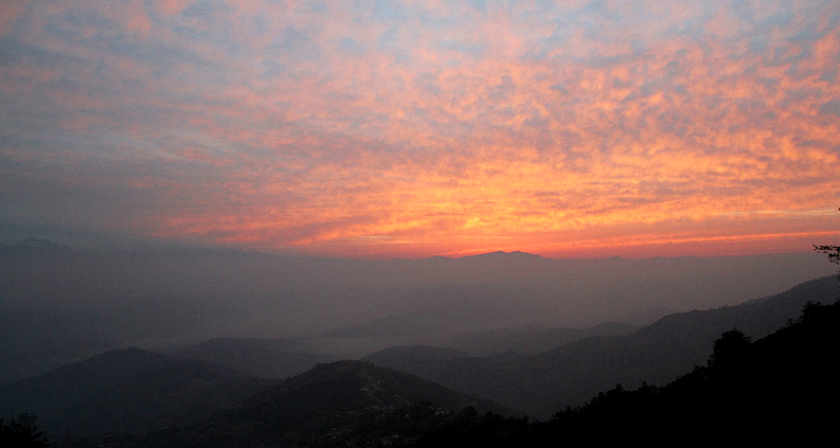
In his book The Happy Isles of Oceania, the genre-bending travel writer Paul Theroux states that “as long as there is wilderness, there is hope.” Theroux, an established novelist and best-selling author of the acclaimed The Great Railway Bazaar, is heartbroken. His marriage is in tatters. Divorce is on the horizon. It is under such circumstances (and with a dark patch on his arm that doctors cannot rule out to be cancer) that he sets out to paddle the isles of Oceania. It is while trekking in the forests of New Zealand that he writes that line about wilderness and hope.
A wilderness is not a panacea, but it does rejuvenate. It’s a visual and physical paradox: surrounding by a mesh of green, we are disentangled from the other nets—the Internet, work, crowds, consumerism, the media. The outdoors offers us sanctuary. Most of us, caught in the labyrinth of daily life, forget this. So much so that the wilderness almost becomes otherworldly, distant, out of reach.
Wildernesses are not simply the haunts of Thoreau-like people. Nor will everyone that goes into a forest return with Wordsworthian sonnets. But nature does trigger creativity in all of us. When a person is in the midst of nature, creativity goes up. David Strayer, a cognitive psychologist at the University of Utah, has demonstrated through a study that backpacking in the wild for three days increases a person’s creative problem-solving abilities by 50 percent. Strayer hypothesizes that the brain relaxes when in nature, allowing much-needed rest for brains exhausted from the constant demands placed on it by urban lifestyles. According to a National Geographicarticle, an hour-long walk in a forest reduces one stress hormone by as much as 16 percent. The same article states that simply looking at pictures of natural landscapes “can calm people down.” That reminded me of being stuck in traffic. I seem to become another person—irascible and impatient. The antidote: Nature. Perusing natural scenes, the article says, light up “the anterior cingulate and the insula—areas associated with empathy and altruism. Maybe nature makes us nicer as well as calmer.”
A sad fact of urban life is that the more urbane we become the less time and space we have for nature in our lives. Life in Kathmandu, like in most big cities, is exacting and stressful. Luckily, there are still places near enough to escape to and immerse in nature.
Shivapuri National Park
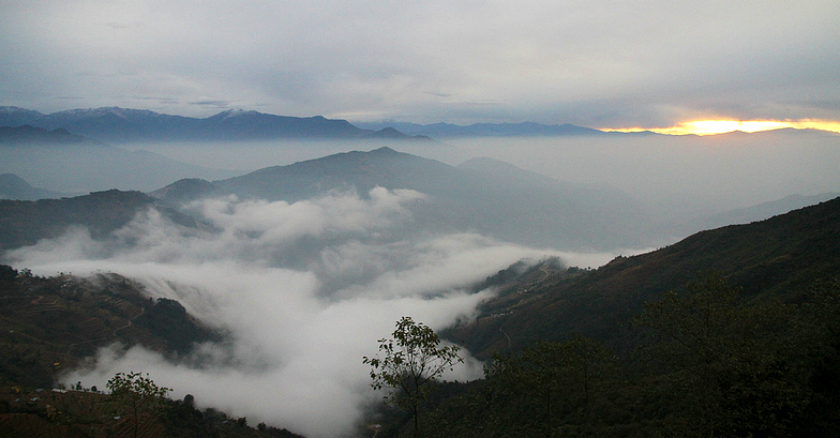
I have often seen this forested pyramid from somewhere on the valley floor and wished I was walking its graveled trails. Shivapuri is far enough and yet not distant, wild enough without requiring Bear Gryllsian survivor skills. Hiking there is easy—unless you decide to go all the way to the peak, which is the equivalent of a leg day at the gym.
As soon as you pass the main gate at Pani Muhan you realize that you are not the only one who is there to seek shelter. Everywhere there are creatures that have been driven out from the valley floor. Bird songs are the soundtrack here, their twitter and whistles so numerous and incessant that it feels like it’s dripping down from the canopy.
For all its natural splendor and profusion, Shivapuri is not otherworldly; Kathmandu, with its veil of smog, is visible from many places on the trail. Nothing earth-shaking about the forest, nothing surreal. Nothing but enough quiet to hear your own crunchy footsteps on the gravel.
Rani Ban
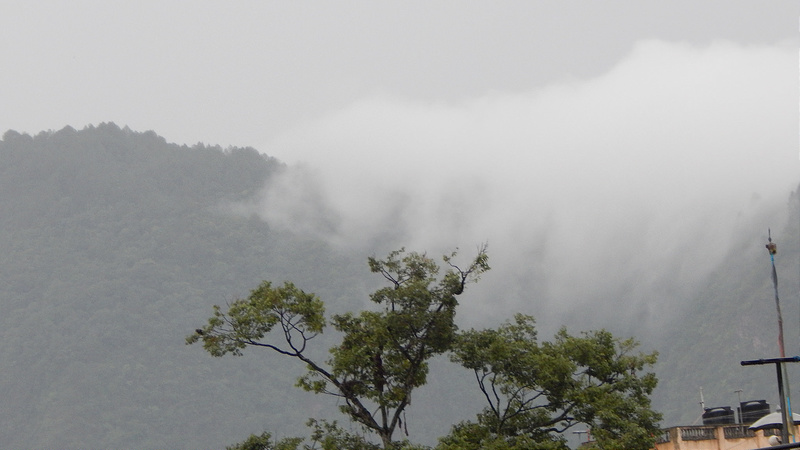
This is a token, a consolation for those sighing at what has happened to Kathmandu green spaces. The fact that a forest has survived in the middle of a sea of concrete makes it a trophy, a small victory for nature. It’s almost a diagrammatic representation of the tussle between the urban and the wild. It lies west (behind) a five-star hotel, is hemmed into the north by the Nepal Police kennel, and in all other directions concrete laps at this green island hungrily, threatening to engulf it.
The topography combined with the fact that this forest was much larger than what it is today makes it a sort of museum, a reminder of what it was. A board next to the entrance lists the various birds that can be seen in the woods: several species of barbets, the magpie robin, owls. It’s also a habitat for joggers, seclusion-seeking couples and anyone who rejoices being embowered by trees.
The Garden of Dreams
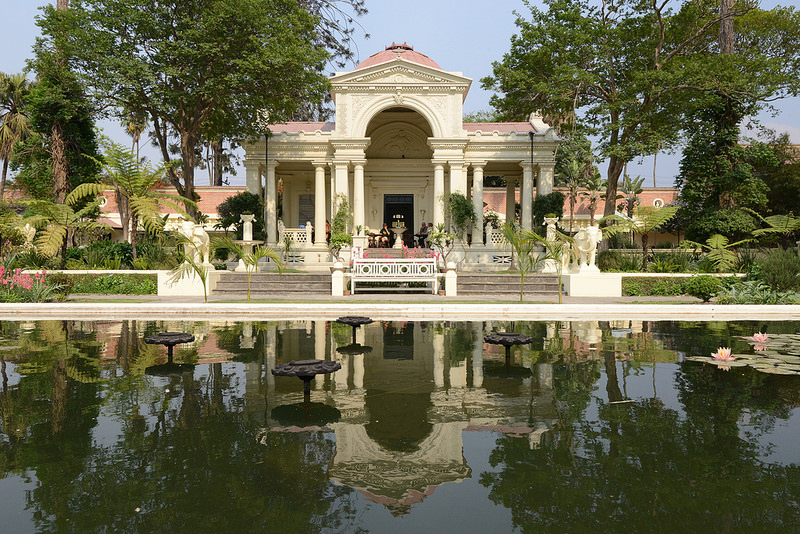
As every empty plot of land disappears from Kathmandu neighborhoods the Garden of Dreams feels like “The Answer to Prayers.” Brought back from ruins and snatched from the maws of urban development, which sought to turn the garden into a mall, this is a true lifeline for nature-deprived Kathmanduites. It is nothing short of a dream when one remembers the frenetic rush of vehicles outside its walls. The neoclassical buildings, each named after the Nepali seasons, are lovely, but what enraptures more is the greenery. From the large pine tree in the southwestern corner to the reed lining the pond to the bougainvillea, everything reminds how rare greenery is elsewhere in Kathmandu. Spend time in the garden and you realize how soothing a bench under a canopy of flowers can be. Sitting on that bench, watching children frolic on the grass and parents calmed by the flowers and the absence of city life, you see that Theroux was right. As long as there is wilderness – a thousand-square-kilometer national park, a tiny wooded area or a restored garden – there is hope.
Friday, November 2, 2018
Chitlang-the historical valley
The villagers thronged to watch the spectacular sight as the porters carried the car balanced on bamboo poles to the rhythmic chanting of ‘hoste-hainse’ (Nepali rallying cry).
In 1940 porters numbering 60, carried a 1939 Daimler-Benz gifted to King Tribhuvan by the then German Nazi Leader Adolf Hitler. The vintage car is kept on display at the Narayanhity Palace Museum. Yet another antique car, the Hudson Phantom, made by the Hudson Motor Car Company, Michigan, Detroit, USA, and brought to Nepal in the mid-1900s ( believed to be Late King Mahendra’s), is on display at the National Museum, Chhauni.
Some 70 years ago, my nonagenarian mother (93 years old now) walked along this ancient trail, when she was a young woman in her early twenties. She was on a long journey to India and back to meet my late father who was stationed in the Nepal Embassy, Delhi. So did everyone on this trail.
For millenniums, even before the dawn of recorded history in Nepal, the trail was trodden by the traders, pilgrims, royalties, foreign dignitaries, monks and commoners alike because that happened to be the only route that connected the Valley of Nepal (Kantipur/Kathmandu, Bhadgaon/Bhaktapur and, Patan/ Lalitpur) with the Terai plains and neighboring India.
The ancient trail
In the mid-1900s, the journey began after a motor vehicle called a lorry shuttled the travelers to Thankot. Afterward, they hit the foot trail to the daunting heights of the Chandragiri hill, which traversed across beautiful villages like Chitlang, Markhu, Kulekhani (a suspension bridge spanned the river then), Chisapanigadi, and the last leg to Bhimphedi. After that, people clambered up a lorry again and left for the terai towns like Hetauda, Amlekhgunj, and Birgunj, the gateway to India.
In 1956, this time-honored beaten path, trodden down for centuries by legions of travelers suddenly turned deserted and a deathly hush fell over the villages along this route. The once bustling settlements turned quiet and isolated . . . like ghost towns. All too soon, the centuries-old dusty footpath over the Mahabharat hills was forgotten and sadly ignored.
In April 2018, Shayeet and I decided to go on a trip to Chitlang, planning to take the return route via Fakhel, and Pharping. We wished to do the ancient Thankot route but as the road widening work was in progress, it was closed for traffic. Instead, we chose the Mata Tirtha dirt road, which climbed to the Deurali Bhanjhyang (the adjacent ridge to Chandragiri) but eventually met with the ancient trail at Kulekhani. We did not foot it like our ancestors did but mountain biked instead.
In April 2018, Shayeet and I decided to go on a trip to Chitlang, planning to take the return route via Fakhel, and Pharping. We wished to do the ancient Thankot route but as the road widening work was in progress, it was closed for traffic. Instead, we chose the Mata Tirtha dirt road, which climbed to the Deurali Bhanjhyang (the adjacent ridge to Chandragiri) but eventually met with the ancient trail at Kulekhani. We did not foot it like our ancestors did but mountain biked instead.
What with the traffic snarl-ups at Kalanki and convoys of heavy vehicles that seemed to bore down on us, the first leg to Gurujudhara proved tricky, needless to mention the quantity of dust and noxious exhaust fumes our lungs must have inhaled en route. Just horrible! At Gurujudhara, we took a left turn and sighed in relief as we headed out towards Mata Tirtha, a Hindu shrine thronged each year by devotees on the mother’s day. The road though paved was rutted and in a bad shape. The ride began with a steep climb. Save for a few houses and tea shops, the signs of human habitation started thinning out after we pedaled a kilometer uphill. After some time the road turned into an off-road motor track.
We were told that the rest of the forest-clad hill to the Deurali heights (2,100m) would be deserted, so we stopped for tea and snacks. I looked up at the towering forested hill and my heart sank. We had to slug it up to the steep dizzying height without a level ground in between. For Sayeet (only 18 years old) it would be like a fun ride but for me, aged 65, it would be punishing. That’s mountain biking! I was ready to take up the challenge!
With nature
With nature
The more we pedaled uphill, the denser the forests got. Tall pine trees spiraled up into the high hills. The lush vegetation appeared like a close-woven carpet of pale green and olive, while a dash of needle wood magenta foliage lent a floral motif to the pattern. The climb continued relentlessly and the going got tougher each second. Even the “granny gear” (the easiest gear) did not help, and I had to dismount at several places, regain my breath and walk the bike. On the other hand, Sayeet took it in stride. “Must be age,” I murmured to myself, my breath coming in gasps.
We stopped now and then to sip water and gaze around. Several spots on the hill offered bird’s eye views of Kathmandu valley—once a fertile bowl, now an untidy clutter of concrete, grey and dull to look at. The sight was pathetic–what with the haze and smog that seemed to smother the life of the valley, once so green and beautiful.
It took us a grueling three hours from Mata Tirtha to crest the Deurali ridge. We stopped for lunch. Lying towards the west, we could see the Chandragiri ridge and the cable car station. The cable-car cabins were moving up and down. The north was overcast, the dull grey cloud denying us a view of the mountains normally seen on a clear day. In favorable weather, both the Chandragiri and Deurali ridges offer a sweeping view of Ganesh Himal, Langtang, Dorje Lakpa, Gaurishankar, and even the mighty Everest.
It took us a grueling three hours from Mata Tirtha to crest the Deurali ridge. We stopped for lunch. Lying towards the west, we could see the Chandragiri ridge and the cable car station. The cable-car cabins were moving up and down. The north was overcast, the dull grey cloud denying us a view of the mountains normally seen on a clear day. In favorable weather, both the Chandragiri and Deurali ridges offer a sweeping view of Ganesh Himal, Langtang, Dorje Lakpa, Gaurishankar, and even the mighty Everest.
It was time to hit the trail, as we had not made even half the journey. After Deurali the downhill was a breeze, freewheeling all the way down to Chakhel, a settlement dominated by the Tamangs. We hurtled down past small settlements and were surprised to find the terraced slopes bedecked with cabbages in full flower in an unbroken chain as far as we could see. Wow, it was indeed a pleasant sight! Apparently, the folks around the place seemed highly industrious in vegetable farming.
Picturesque Markhu
After Chakhel, at Mahadevsthan, we took the right fork on the Pharping-Phakhel road towards Kulekhani. After pedaling down and up for an hour and a half, we arrived at Kalanki, a bunch of teashops perched on a hillside that sharply dropped to the Kulekhani dam and the enormous reservoir that stretched north as far as our eyes traveled–a breath-taking sight indeed. The road to our left dropped to the dam and the right headed towards Markhu. We stopped for tea, a little tidbit and a much-needed respite. It was already four in the afternoon. We soon left for Markhu, seven kilometers away. The Kulekhani reservoir kept us company all the way.
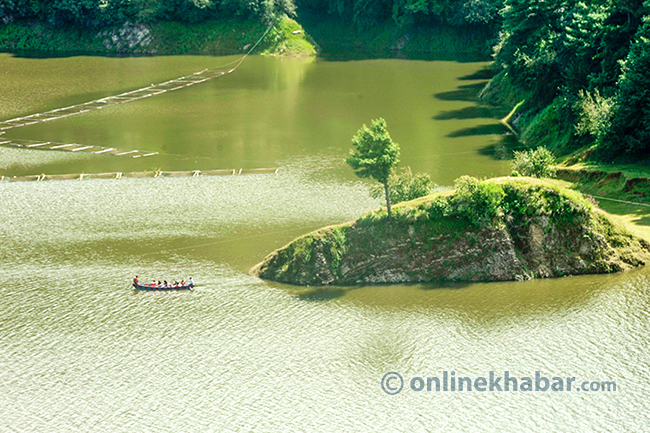
Markhu, a cluster of roadside shops and tea houses appeared quite busy. The landscape around, however, took a dramatic change. We suddenly found ourselves amidst tall, evergreen trees, with the hills around dotted with small houses and terraced fields that dropped to the man-made lake. A picture postcard setting, indeed! The reservoir at Markhu turned into a beautiful wide lake called the Indrasarovar.
The surrounding was so picturesque that we just could not help stopping, looking around and gazing at the big lake. Awesome! We could see a number of small rowing boats on the lake waters. A handful of restaurants and lodges marked the pleasant hillside.
Markhu is known for a local delicacy too— fresh fish from the reservoir. “People from Hetauda, Birgunj and as far away as Kathmandu, make frequent visits to savor the fish, boat the serene waters and relax,” informed one of the restaurant owners. A village elder told me that the suspension bridge across the Kulekhani river built by Chandra Shumsher, which people crossed while doing the ancient route, was submerged and almost 500 families were displaced when the dam and the reservoir (Kulekhani) was built in 1982-83. The entire villages on its course were inundated.
The bazaar area also boasted an old Victorian style building built by the Rana Prime Minister Juddha Shumsher (1932-1945), which in the olden days served as a rest-house for Rana nobilities and foreign dignitaries traveling to Bhimphedi, the point from where they traveled to Birgunj in motor vehicles.
Then, it started pouring after we had pedaled hardly a kilometer up from Markhu. We had to stop and take shelter under the overhanging eaves of a house. After something like 45 minutes, the rain seemed to slacken. We put on our rain-jackets and resumed our ride. I was afraid that we would not be able to make it before dark to Chitlang because it was still like 7-8km to our destination. The ride got moderate with a few steep inclines thrown in. Phew!
My fears were not unfounded.
My fears were not unfounded.
The shadows lengthened as the sun went down and darkness soon crept in as we sped past tiny settlements. Lights started appearing in the distance. We fixed the lights on our bike handles and continued on. It was pitch dark when we arrived at a fork: the left went to Toukhel and the right to Chitlang.
We saw a light, which appeared like a tea shop. “Hello, how far is the goat-cheese homestay at Chitlang from here, bhai (bro)?” I stopped to ask a young fellow. He looked at our bicycles and said, “at least two hours.” It was already seven and we were making very slow progress as the darkness was black as coal. The visibility was reduced to barely 10 feet, the bumpy road frequented by muddy pools and shallow trenches.
Destination at last
Saddle soreness is a horrible thing to happen to a biker but it does, no matter whom it is a pro or a beginner. A long time in the saddle causes the soreness and it sure hurts. Padded shorts specially made for mountain biking helps so does an application of Vaseline (petroleum jelly) to your perineum. We were pedaling in the saddle for almost 7 hours. We had our padded shorts on, applied a liberal quantity of Vaseline and often stood up on our bikes to give our butts a bit of a break and to restore blood flow. But it still hurt. Damn!
After something like one-and-a-half hours of pedaling in the pitch-black night across spooky dark shadows of wooded hills with no settlements or lights in sight, I was a little worried. I kept asking Shayeet if we took a wrong turn somewhere–there was no telling because it was just too dark and confusing. “No, I don’t think we ever came across a fork. We’re dead on the track,” he answered but sounded uncertain. Then, after doing a short downhill section, lights started appearing in the distance.
Our faces lit up, Chitlang, at last! It was already nine at night.
The streets were muddier along the deserted bazaar. We finally made it to the homestay at around 9.30pm after dodging potholes and deep ruts with heavy slush. Phew, we had done in excess of 120km that day! Since we had called the lodge earlier, we had no problem getting food and a room for the night. Deadbeat as we were, nothing could be more welcome than a hot meal and a cozy bed. We wasted no time and hit the sack after food.
2.0 Trailer Launch : Superstar Rajinikanth and Khiladi Akshay Kumar have arrived
The wait is about to get over
Subscribe to:
Posts (Atom)
आज नायक पल शाहको आज जन्म दिन ,जन्मदिनको पूर्वसन्ध्यामा पलले गरे द्वन्दपिडित बालबालिकालाइ सहयोग [भिडियो ]
नेपाली रजतपटका लोकप्रिय नायक पल शाहको आज जन्म दिन परेको छ । नायक शाह जन्म देखि केहि दिनअघिमात्र सर्लाह्री जिल्ला पुगी द्वन्दपिडित बालबालि...

-
Yes, curiously, it also came to be known as the ‘Rolls Royce’ trail as the first ever automobile (in 1934), and subsequently, o...
-
Pradeep Khadka; Nepali Actor Nepali movies are rumbling to the peak. Its collection has blessed cinema box office because more number of...
-
Deglamorize but yet alluring, simple but yet sophisticated and stylish, all these came alive under one roof of Arshiya Couture, bridal co...


